Mergers and Acquisitions (M&A)

Narrative: ESOP vs. “Normal” Company Valuation Outcomes

While ESOP-owned companies and non-ESOP companies are generally valued under the same fair market value (FMV) standard, the resulting conclusions can differ materially due to structural, economic, and regulatory factors inherent to ESOP transactions.

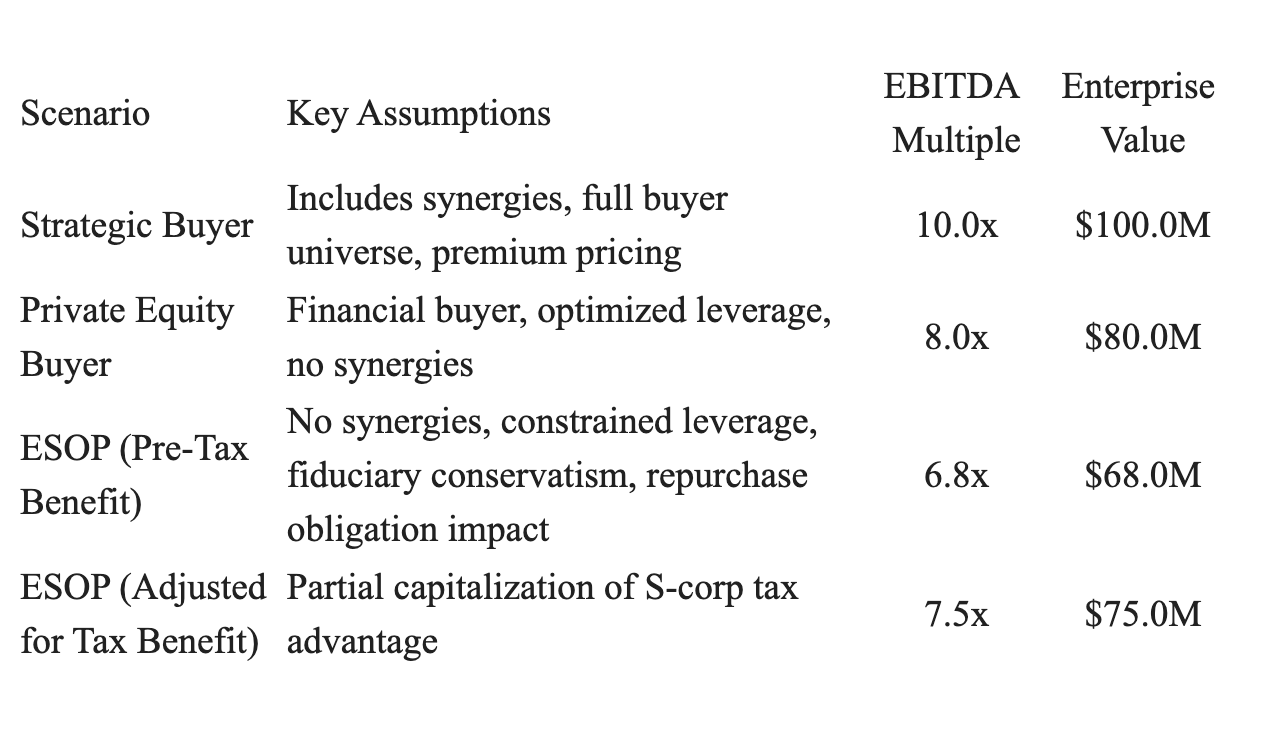
In a conventional valuation context, the hypothetical buyer universe includes both strategic acquirers and financial sponsors, and therefore implicitly reflects the highest and best use of the business. Strategic buyers, in particular, may incorporate expected synergies—such as cost savings, revenue enhancement, or market consolidation—which can support premium valuation multiples. Private equity buyers, while not paying for synergies to the same degree, often utilize optimized leverage structures to enhance returns, supporting competitive pricing.

In contrast, an ESOP transaction is fundamentally different. The buyer is not a market participant in the traditional sense, but rather a trust acting on behalf of employees, subject to ERISA fiduciary obligations. As such, the ESOP must pay no more than adequate consideration, interpreted as fair market value under a prudent and defensible process. This eliminates the influence of strategic synergies and constrains the valuation to what a financial buyer with limited leverage capacity can support.

Additionally, ESOP-owned companies introduce unique economic considerations that directly affect value. One of the most significant is the repurchase obligation, which requires the company to buy back shares from departing employees. This obligation functions as a long-term cash flow claim, effectively reducing the free cash flow available to service debt or distribute value, and therefore placing downward pressure on valuation.

Conversely, ESOP structures—particularly S-corporation ESOPs—benefit from a substantial tax advantage, as the ESOP-owned portion of the company is generally exempt from federal income tax. This increases after-tax cash flow and, in theory, enhances value. However, in practice, this benefit is often only partially capitalized in valuation due to fiduciary conservatism and ongoing regulatory scrutiny.

Further differences arise in the treatment of control and marketability. Although ESOPs frequently acquire controlling interests, the absence of a liquid external market for shares necessitates consideration of a discount for lack of marketability (DLOM). At the same time, any control premium must be carefully justified and is often tempered or offset by the lack of liquidity.

Finally, ESOP valuations are influenced by a heightened emphasis on defensibility. Given the potential for Department of Labor (DOL) review and litigation, valuation assumptions—such as projections, discount rates, and terminal values—tend to be more conservative, further contributing to differences in outcome relative to a typical market-based valuation.

Taken together, these factors generally result in ESOP valuations that are lower than strategic transaction values and often comparable to or modestly below private equity valuations, depending on the specific facts and circumstances.

Illustrative Valuation Comparison

Assumptions:

  • EBITDA: $10.0 million

  • Identical underlying business across scenarios
Summary Insight

The divergence in valuation outcomes is best understood as a function of buyer-specific constraints and structural economics, rather than differences in underlying business performance.

In effect, a traditional valuation reflects what the business could command in a competitive market, whereas an ESOP valuation reflects what a fiduciary-bound, financially constrained buyer can prudently pay, given regulatory obligations and long-term sustainability considerations.

Selling a Distressed Entity

When you envision selling your company, you hope it’s healthy and in the most appealing state for buyers in the market. Unfortunately, that’s not always the case. The economic adage “sell high, buy low” is not applicable when one is required to sell a distressed entity.

Generally, a distressed entity needs to rely on non-tangible assets to yield the optimal value. For example – customer list, intellectual property, management team, etc. A few things to consider when trying to sell your distressed entity:

  • Be candid: do not hide the problems. Once the buyer commences the due diligence, they will find the issues and then some, so be forthright.

  • Be realistic about the enterprise value: If possible, have a professional valuation performed on the business.

  • Highlight your strengths: Perhaps you’re not in the most financially stable position, but your executive team may be a critical component of the team that can take your company to the next level.

  • Work with a proven counsel and financial advisor: More than likely this will not be your current tax preparer of corporate counsel – you need professionals that are aware of all the nuances of these transactions.

  • If the company is in distressed, do not delay in your decisions: Time is the #1 factor.

  • Be prepared: Have all the financial statements, corporate information, and operational information available to the potential buyers in a professional format and structure.

  • Don’t lose hope or focus: Selling a distressed entity requires a lot of time and focus. You can’t drop everything to try and sell your business otherwise it will further decline. Keep morale up and work on improving your business as much as possible during the process.

Tax Planning for Exit Strategies

There is no doubt that exit planning and its execution are complex and challenging. The exit planning is critical and can save the seller a significant amount of funds. With a fifteen-month plan to exit your business with the proper planning and execution – the seller should be able to add another 30% to his / her net proceeds. This is possible because it:

  • Provides you with the time to properly “clean-up” the balance sheet;

  • Eliminates unnecessary costs. Remember that each dollar you save or add will within the next 18 months generate a significant result. For example, if the company has a valuation multiple of 6, then every dollar improvement in EBITDA generates you, the owner, 6 dollars. This is not a bad ROI. The general pitfall is there are “too many sacred cows”;

  • Allows the inventory to be optimized;

  • Assures you have the right team. Too many low / middle market companies do not have the bench strength once the owner leaves. Or even worse, the bench strength comes from family members. Develop a team knowing the short-term and long-term strategy and share the upside opportunity with them. If done properly, these key individuals will generate their savings several fold in comparison to the costs;

  • Incentivizes all the key players to ensure everyone is on the same page; and

  • Gives you time to meet with your tax advisor very early in the process to ensure you minimize your tax exposures and / or obligations. Ensure that your tax advisor is an expert in the M&A phases of business. This is a very complex set of transactions – this is not the time to have an inexperienced player. After all – this business sale may be the most important financial transaction in your life.

From a tax perspective, you, the owner, should have a solution to the following tax issues:

  • What Type of Entity Do You Use to Conduct Your Business?

  • Is a Tax-Free Deal Possible?

  • Are You Selling Assets or Stock?

  • Allocation of Purchase Price is Critical.

  • Other Payments to Sellers; Personal Goodwill.

  • Installment Sales (Seller Financing) and Escrows.

  • Earnout/Contingent Payments.

  • Outstanding Stock Options.

  • State and Local Tax Issues.

  • Pre-Sale Estate Planning.

Selling a Company

There are many different ways of selling a company. Choosing a method may depend on the type of business, the goals of the seller, or the preferences of the buyer. Here are some common methods for selling a company:

Sale of the Company’s Shares: This is when the seller transfers all or some of the ownership shares of the company to the buyer, who then becomes the new owner of the company. This method is simpler and faster than a sale of assets, as it does not require the transfer of individual assets and liabilities. However, it also exposes the buyer to more risks, such as hidden liabilities, tax issues, or legal disputes.

Pros

  • Simplicity and Speed: Faster and simpler transfer of ownership

  • Ease of Transition: Current management structure and employees usually remain intact

Cons

  • Risks: Buyer assumes existing liabilities, potential legal issues, and hidden debts

  • Limited Control: Limited control over individual assets and liabilities

Sale of the Company’s Assets: This is when the seller sells the individual assets and liabilities of the company to the buyer, who then uses them to operate a new or existing business. This method gives the buyer more flexibility and control over what they are acquiring and reduces the risks of inheriting unwanted liabilities or problems. However, it also involves more complexity and costs, as it requires the valuation and transfer of each asset and liability and may trigger tax consequences for both parties.

Pros

  • Flexibility: Buyer can pick and choose specific assets, avoiding unwanted liabilities

  • Clear Valuation: Easier valuation of individual assets

Cons

  • Complexity: Involves detailed valuation and transfer of each asset and liability

  • Cost: More expensive due to legal and valuation expenses

Merger or Acquisition: This is when two or more companies combine their businesses into one entity, either by merging their shares or assets, or by one company buying out another. This method can create synergies and economies of scale, increase market share and competitiveness, and diversify products and services. However, it also involves challenges such as integration issues, cultural differences, regulatory approvals, and potential conflicts among stakeholders.

Pros

  • Synergies: Can create synergies, increase market share, and diversify products/services

  • Competitive Edge: Enhances competitiveness and market presence

Cons

  • Challenges: Integration challenges, regulatory approvals, and potential stakeholder conflicts

  • Cultural Differences: Differences in organizational culture can lead to challenges

Management Buyout: This is when the existing management team of a company buys out the ownership shares from the current owner, usually with the help of external financing. This method can preserve the continuity and culture of the business, motivate, and reward the management team, and avoid disruption to customers and suppliers. However, it also requires a high level of trust and cooperation between the owner and the management team, a fair valuation of the business, and a feasible financing plan.

Pros

  • Continuity: Preserves business continuity and company culture

  • Motivation: Motivates existing management team and key employees

Cons

  • Financing: Requires substantial external financing

  • Valuation: Needs a fair valuation process to satisfy both parties

Employee Stock Ownership Plan (ESOP): This is when a company sets up a trust that buys and holds its shares for the benefit of its employees, who then become partial owners of the business. This method can provide tax advantages for both the seller and the company, increase employee loyalty and productivity, and facilitate succession planning. However, it also entails administrative costs and complexity, fiduciary responsibilities for the trustees, and dilution of ownership for existing shareholders.

Pros

  • Loyalty: Increases employee loyalty and productivity

  • Succession Planning: Facilitates succession planning and smooth transition

Cons

  • Complexity: Involves administrative complexity and fiduciary responsibilities

  • Dilution: Dilutes ownership for existing shareholders

Strategic Sale: This involves selling your company to another company in the same industry. Strategic buyers are often willing to pay a premium because they see synergies and opportunities for growth or cost savings by acquiring your business. These buyers could be competitors, suppliers, or companies in related industries.

Pros

  • Premium Pricing: Strategic buyers often pay a premium due to perceived synergies

  • Industry Expertise: Buyers understand the industry, which can lead to smoother transitions

Cons

  • Limited Pool: Limited to companies in the same or related industries

  • Sensitivity: Sensitive information might be shared with competitors

Financial Sale: Private equity firms or investment groups may be interested in acquiring your company purely for its financial returns. They often buy companies with the intention of improving their performance and selling them at a higher valuation in the future.

Pros

  • Financial Expertise: Buyers can optimize the company’s financial performance

  • Profitable Exit: Potential for significant financial gains

Cons

  • Ownership Changes: Likely significant changes in company management and culture

  • Exit Pressure: Pressure to meet financial targets can affect company decisions

IPO (Initial Public Offering): If your company is large enough and meets the regulatory requirements, you can take it public by offering shares on a stock exchange. This allows you to raise capital from public investors and gives you liquidity.

Pros

  • Capital Infusion: Raises significant capital by selling shares to the public

  • Liquidity: Provides liquidity to existing shareholders

Cons

  • Regulatory Compliance: Strict regulatory requirements and ongoing compliance

  • Market Volatility: Vulnerability to market fluctuations affecting stock prices

Brokerage Services: You can hire a business broker or investment banker to help you find potential buyers and negotiate the sale on your behalf. These professionals can provide valuable guidance throughout the process.

Pros

  • Professional Guidance: Benefits from the expertise of professionals

  • Networking: Brokers have industry connections for potential buyers

Cons

  • Cost: Involves fees and commissions, affecting overall proceeds

  • Dependency: Relies on the broker’s effectiveness in finding suitable buyers

Online Marketplaces: There are online platforms and marketplaces where you can list your business for sale. These can be effective for smaller businesses and startups.

Pros

  • Accessibility: Provides a wide reach to potential buyers

  • Cost-Effective: Generally lower cost compared to traditional methods

Cons

  • Quality Control: Quality of buyers may vary; careful screening is necessary

  • Limited Scope: May not be suitable for larger, more complex businesses

Direct Sale: You can also approach potential buyers directly, especially if you already have contacts or relationships in your industry. This approach requires careful negotiation and due diligence.

Pros

  • Relationship-Based: Relies on existing industry relationships

  • Negotiation Control: Direct involvement in negotiation processes

Cons

  • Resource-Intensive: Requires significant time and effort for due diligence

  • Limited Reach: Limited to existing industry connections

Each method has its own advantages and challenges. It is essential to carefully evaluate these factors and seek professional advice before making a decision. These are some of the most common methods of selling a company, but there may be other options depending on your specific situation. You should consult with your team of advisors before deciding on the best method for your business.